Research · Atlas · Italy
Augusto Oppo and Osvaldo Licini: landscape, sign and celestial figures
Six works from the catalogue test a comparison centred on landscape, sign and celestial figures: formal convergences, historical differences and documentary boundaries.
Abstract
Licini transforms the landscape of the Marche into a mental space inhabited by signs and creatures; Oppo allows horizon, moon and figure to migrate towards abstraction without fixing them in an equally compact personal mythology.
Landscape, sign and celestial figures: framing the problem
A visual affinity is a fragile starting point. In the case of Osvaldo Licini, the question of landscape, sign and celestial figures can clarify part of Oppo’s work only if technique, chronology, scale and context remain in the foreground.
Licini transforms the landscape of the Marche into a mental space inhabited by signs and creatures; Oppo allows horizon, moon and figure to migrate towards abstraction without fixing them in an equally compact personal mythology.
The Archive repository currently contains no documents attesting personal acquaintance, direct study or influence. Information about the other artist comes from the institutions cited; readings of Oppo’s works combine catalogue data with explicitly identified visual interpretation.
Osvaldo Licini: historical coordinates
Licini’s trajectory passes through figuration, the abstraction of the 1930s and the late constellations of Amalassunte and Rebel Angels. The official website and the Centro Studi in Monte Vidon Corrado together document paintings, works on paper, letters and his substantive relationship with the landscape he inhabited.
Licini’s phrase ‘signs, not dreams’, cited by the Italian Ministry of Culture, cautions against a purely fantastical reading. The celestial figures are precise pictorial constructions. In Oppo, the sign may evoke cosmos and territory, but it remains more intermittent, often close to graphic art or matter.
The critical point of comparison
Licini is useful because he shows how little painting needs to reactivate a presence: a moon, a profile, a letter, an inclined sign. In Oppo, celestial forms and thresholds of the horizon can produce a comparable suspension, but remain tied to the individual work. The catalogue does not allow them to be gathered into a coherent mythology or assigned a stable narrative identity.
The difference also lies in the title. Licini’s titles participate in the poetic construction of the work; many titles in Oppo’s catalogue are descriptive designations introduced by the Archive to identify works without a documented title. To confuse these levels would turn a cataloguing tool into the artist’s intention. The comparison must therefore remain anchored in visible forms and the verified status of names.
Six works, a verifiable perimeter
The selection brings together ASO-0004, ASO-0512, ASO-0528, ASO-0529, ASO-0535, ASO-0063 and spans from 1981 to 1995. Documented materials include acrylic on paper and acrylic or synthetic medium on wood. These data do not construct an automatic evolutionary sequence: they define the verifiable perimeter within which to discuss landscape, sign and celestial figures, excluding less pertinent works and without turning the absence of a recorded technique into positive information.
The first three works—‘Ascensione blu’, ‘Origami del cielo’, ‘Corpo celeste’—bring the initial formulation of the problem into focus; ‘Passaggio lunare’, ‘Costellazione bianca’, ‘Mare’ test its variations, returns or departures. The order is argumentative and does not replace the artist’s general chronology. It prevents a single work, selected for its resemblance, from becoming unwarranted evidence for the corpus as a whole.
Within the group ASO-0004, ASO-0512, ASO-0528, ASO-0529, ASO-0535, ASO-0063, catalogue status remains part of the argument: all 6 titles are Archive designations and are not attributed to the artist. Dimensions are recorded for all 6 works; where technique, date or dimensions are missing, the text preserves the documentary gap. Visual analysis describes relationships verifiable in the image, but does not fill those gaps with unattested intentions, provenances or circumstances.
First sequence: structure, edge and interval
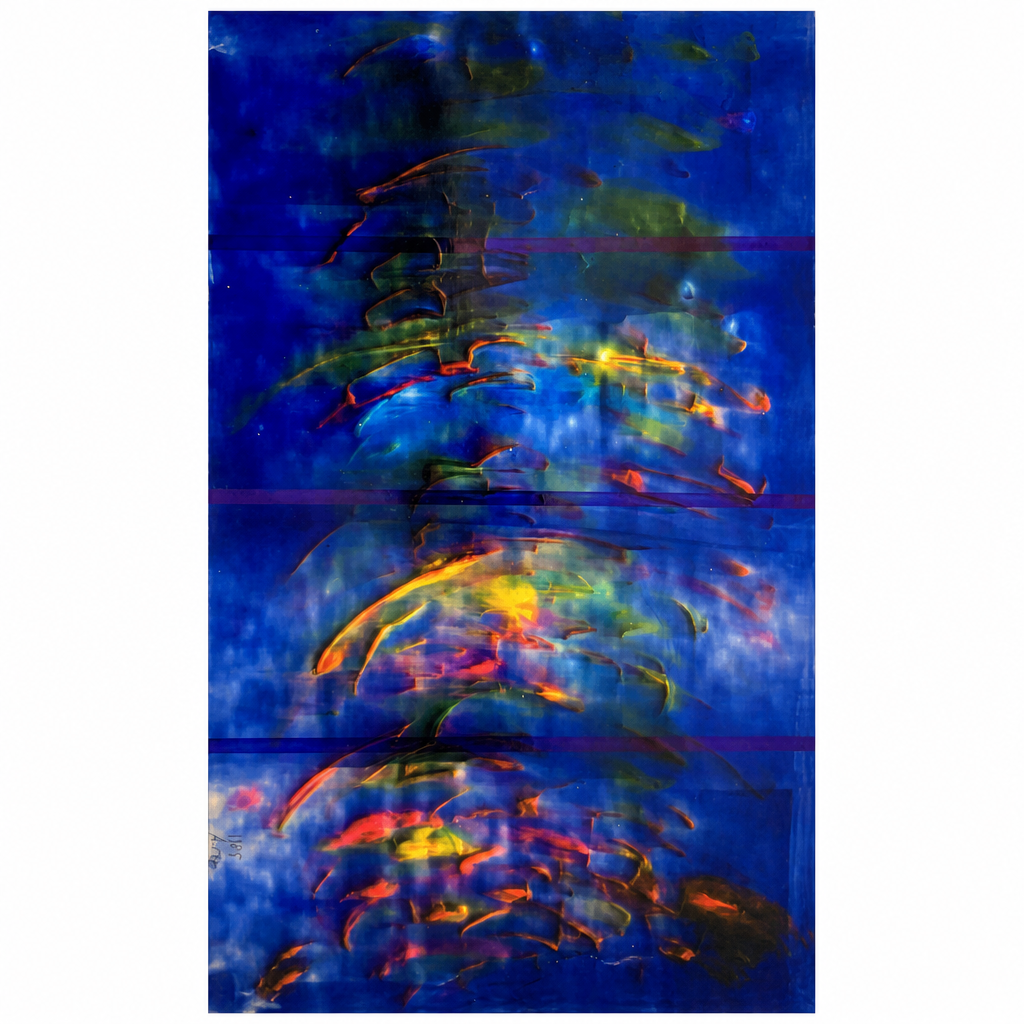
ASO-0004, Ascensione blu, s.d., Acrylic on paper. Augusto Salvatore Oppo, Profondo blu, undated. Synthetic medium on cardboard. In this vertical abstract composition, a saturated field of cobalt and ultramarine blue is crossed by broad gestural marks concentrated along the central axis. Flashes of yellow, orange, red and green emerge through the layered colour, while three dark horizontal bands structure the surface. Transparencies, overlaps and shifts in light give the image a deep, dynamic rhythm. In considering landscape, sign and celestial figures, the decisive point is how the construction remains visible without becoming an impersonal scheme.
ASO-0512, Origami del cielo, 1995. Folded, overlapping forms rise from the earth towards two great luminous curves. Pale yellows, greys, browns and blues construct an image that may recall mountains, paper wings or an opening organism; no reading prevails over the others. Dated 1995, the composition holds lightness and weight together with an almost architectural discipline. Oppo brings geometry into contact with the imagination, allowing the sky to seem born from the very folds that organise matter. Here the comparison concerns what form does: it measures, interrupts and directs the field; it does not prove a historical derivation.
ASO-0528, Corpo celeste, s.d.. Great blue and white curves cross the sheet, joined by red ribs and smaller marks recalling orbits, limbs or plant fibres. There is no stable centre: the composition expands in several directions and seems to continue beyond the edges. Oppo brings anatomy and cosmos into relation without describing either. The body becomes space and space takes on an organic quality, in a luminous vision where every form belongs to a larger movement. The work resists reducing this question—landscape, sign and celestial figures—to a label: support, edge and intervals retain different responsibilities.
Second sequence: variations and discontinuities
ASO-0529, Passaggio lunare, 1981. Two dark fields face one another, separated by a black axis running through the entire composition. Pale discs, arches, taut lines and sudden red flares construct a passage between different spaces, as though an earthly night opened onto another dimension. Dated 1981, the work unites geometric discipline with cosmic imagination. Oppo does not represent the moon: he uses its presence to measure distance, attraction and threshold, allowing darkness to become a navigable structure. Its relevance arises from the problem addressed, while technique, scale and chronology set the limit of the analogy.
ASO-0535, Costellazione bianca, s.d.. Violet, grey, yellow and green marks emerge with differing intensity from an almost white field. Some gather into a denser vertical form, while others remain isolated, like points in a constellation on the verge of dissolving. Empty space is not a neutral background: it absorbs, softens and brings every trace into relation. Here Oppo takes matter to a threshold of extreme lightness, allowing the image to exist in the fragile balance between what appears and what light is already erasing. This passage makes a solution specific to Oppo legible: form remains open to memory and change.
ASO-0063, Mare, s.d., Acrylic or synthetic on wood. Mare arranges the surface in three vertical zones, where the raised blue texture enters into dialogue with a broad glossy black field and the blue lettering across the lower band. The contrast between rippled matter and reflective plane turns the marine theme into an almost graphic construction. The pale frame holds the image as a compact object, while the rhythm of the word becomes part of the composition. The work belongs to the Collezione Mare and measures 60 x 80 cm. The catalogue entry therefore supports an argument about what can be seen, without filling gaps in the documents with hypotheses.
Where an affinity emerges
The convergence lies in the way a figurative residue can inhabit abstract fields without reconstituting a traditional scene. Moon, horizon and body become unstable coordinates.
The convergence therefore concerns an operation, not a physiognomy: how the experience of the painting is organised through landscape, sign and celestial figures. Selecting six works avoids treating a single detail as evidence for an entire trajectory.
Considered together, the catalogue entries also reveal Oppo’s plurality. Years, supports and titles do not converge in a definitive formula; the same problem is reopened and altered, sometimes decades apart.
Where the analogy ends
Licini organises a personal iconographic universe, supported by titles, letters and recognisable recurrences. In Oppo’s catalogue, celestial apparitions form one group among others and do not warrant the assumption of a unified symbolic system.
The name Osvaldo Licini defines an exhibition, critical and technical history that cannot be transferred to Oppo by analogy. Movements and groups are mentioned only to situate the comparative source, not to assign an affiliation retrospectively.
The public scale of the two careers also differs. This asymmetry does not invalidate the comparison, but requires it to operate in both directions: the other artist clarifies a question; Oppo’s corpus offers an independent answer and reveals its limit.
An independent solution
The result is a more precise placement. Licini transforms the landscape of the Marche into a mental space inhabited by signs and creatures; Oppo allows horizon, moon and figure to migrate towards abstraction without fixing them in an equally compact personal mythology. Oppo’s specificity emerges from his mobility between painting, graphic art, relief, object and design, not from assimilation to an already canonical language.
The comparative atlas therefore retains this page among its strong comparisons: the works sustain the comparison, the differences remain decisive, and any future documentary hypothesis can be added without confusing fact and interpretation.
Works examined
Catalogue works that provide the visual evidence for the argument.


Sources and selected bibliography
- museum Official Osvaldo Licini website: biography, works and documents
- Archive document Augusto Oppo Archive, digital catalogue raisonné of the works, 582 entries consulted
- Archive document Augusto Oppo Archive, Augusto Oppo: a lateral modernity
Critical comparison proposed by the Archive. No documents have been found attesting a direct relationship between Augusto Oppo and Osvaldo Licini; formal affinities, historical data and interpretative hypotheses are kept distinct.