Critical reading
Occhi chiusi (1985): a face between figure and surface
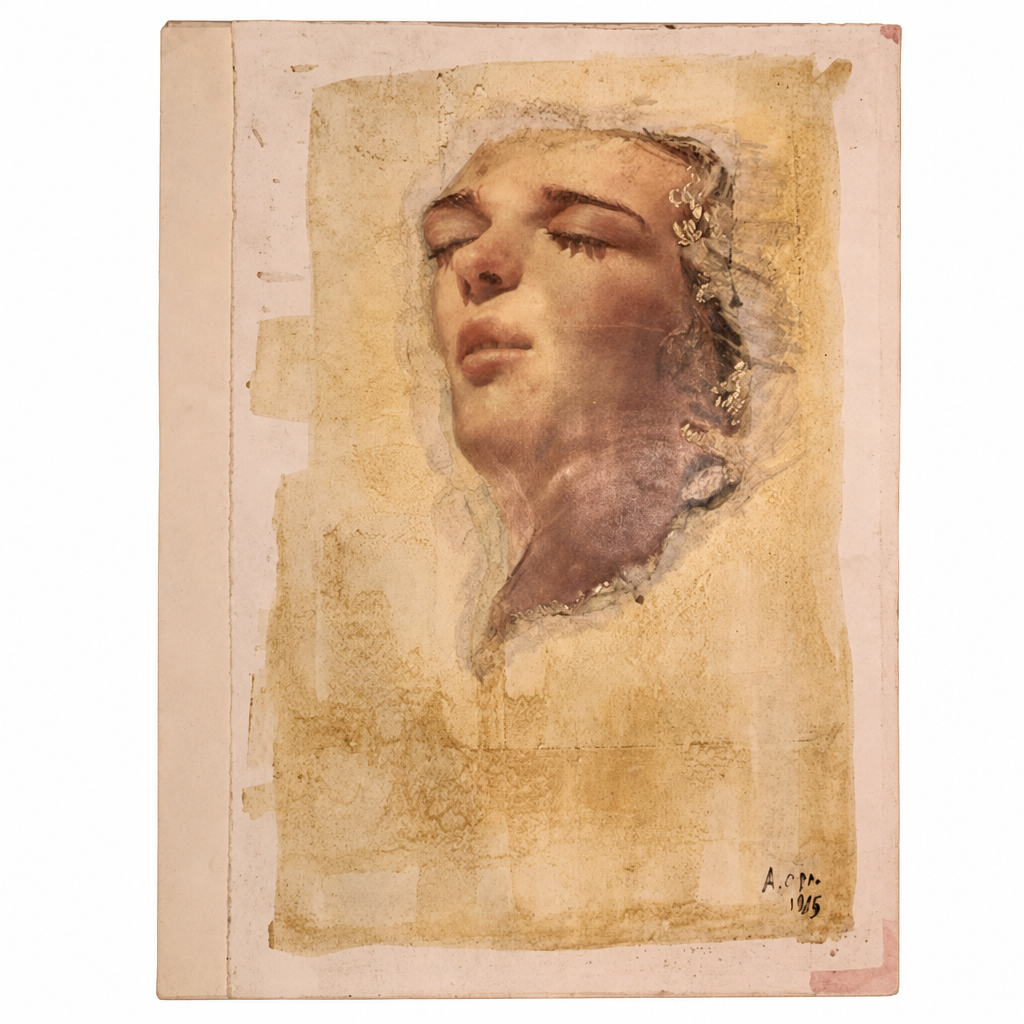
A woman’s face emerges from an ocher field, eyes closed and head slightly raised. The figure is most intense where it fades into the surface.
Critical Reading
The record for Occhi chiusi dates the work to 1985 but gives no materials. Its title is an archive catalogue designation, not a documented title in the artist's hand. A woman's face dominates the image, emerging in the upper half of an ocher field. The eyes are lowered, the head tipped slightly upward and turned three-quarters; the neck descends into a brown area that merges with the ground. A broad light expanse remains beneath the head, crossed by small marks and shifts of tone. The composition draws attention to expression, but gives equal weight to the space in which the figure appears and gradually dissolves.
The head is not placed exactly at the center. It shifts to the right, leaving a wider band of light ground on the left. This asymmetry makes the image less like an identification photograph and more like an apparition constructed within a rectangle. Forehead and nose catch the strongest light; the right cheek and neck descend into warm browns. Hair, or the framing of the head, is barely suggested along the right edge with small light and dark touches. No hard outline completely separates face from the surrounding field.
The eyes are decisive. Closed lids and lashes form two dark lines beneath the brows. The mouth is slightly parted or merely relaxed, but that observation cannot become a diagnosis of the figure's inner state. The face may seem collected, absorbed, or suspended; the image does not establish whether this is sleep, meditation, or a pose. Oppo entrusts intensity to a minimal visible gesture and withdraws the reciprocity of the gaze. We look without being looked at, becoming more attentive to the modeling of skin and its transition into the ground.
The field around the face has its own structure. On the left a vertical line and several pale rectangular edges suggest overlapping layers; above the head and below it are denser zones, stains, and irregular textures. Their appearance may recall a worn surface, but the photograph cannot securely establish their material origin. The ground does not describe a place. It gives the face a space from which to emerge and counters the head's relatively greater precision. The figure becomes distinct because the color around it remains open, not because it has been cut out against a uniform plane.
In the lower area ocher becomes lighter, allowing almost calligraphic marks to show through. The head thus seems suspended over a field that becomes neither torso nor landscape. The signature and date, legible at lower right, provide a fixed point on the edge of this unstable zone. The photographed sheet or support also retains a light border, a reminder of the work's physical limits. The overall effect depends on the difference between a face rendered in warm gradations and the rest of the surface, where those same tones disperse into traces.
The archive title accurately names the most recognizable feature, but it does not exhaust the composition. Attention confined to expression would miss the relationship between upper and lower parts, modeled skin and irregular field. It is this relationship that distinguishes the work from a conventional portrait. The subject's identity is unknown, and the record proposes none. The picture therefore asks us to consider the figure through her manner of appearing, rather than through a private history assigned after the fact.
Critical Aspects
The first caution concerns technique. The materials field is blank, and the photograph shows a very fluid transition between face and ground. From this reproduction, we cannot tell whether the effect comes from painting, print, work on an image, or several processes together. Analysis may describe soft modeling, apparent washes, and surface texture; assigning tools or a sequence of operations would be an undocumented reconstruction. Such caution matters especially because the difference in definition between head and ground could result from very different technical processes.
A second risk is psychological interpretation. A face with closed eyes invites words such as serenity, surrender, or inward listening. These are possible impressions for viewers, not observations on the same footing as pose or color. The catalogue description suggests a state of withdrawal; the composition allows us to discuss it as an effect, provided we do not turn it into a certain intention of the artist or an emotional state of the sitter. The work is richer when expression remains open to several perceptions instead of being fixed under a single label.
The face's much greater definition compared with the rest of the surface creates a real tension. It attracts attention at once and could make the ground appear a merely decorative frame. Longer looking reveals that pale bands and lower textures regulate the head's isolation and change its weight. Without them, the image would be more direct and less suspended. The ground has no independent subject, but it serves a precise compositional task: to make space for the figure without giving her a narrative setting.
In Oppo's 1985 corpus, Luogo di ascolto presents a half-length figure among fields of blue, green, and violet, its face reduced to a few marks. Comparison shows a reversal: there, body and chromatic frame take up much space; here, the face concentrates definition as the body disappears. The 1958 Portrait of Maria Luisa Demarchi offers another useful distance: a person identified by the family and constructed with mobile lines and blues, against the anonymous subject and warm tones of Occhi chiusi. Similarity of genre does not justify identifying the 1985 sitter.
Evaluation
Occhi chiusi has immediate force, owing to the scale of the face and the pose's apparent calm. Its more lasting quality, however, emerges in the passage between what can be clearly perceived and what remains blurred. Forehead, eyelids, and lips hold the gaze; the ocher zone around the head moves it away and then draws it back. The picture thus builds a slow rhythm suited to its subject without having to illustrate a scene or a particular emotion.
The legible date and the work's place in the corpus allow comparisons with other figurative works, but the missing materials information places an important limit on technical interpretation. Keeping that limit in view does not impoverish assessment. It redirects attention to what the image genuinely lets us see: distribution of tones, the face's asymmetrical placement, and a lower surface left more open. In these features the work reveals an inquiry into human presence through the relationship between figure and field.
The archive title names a detail, the eyes, and makes the work easy to find. The image goes beyond that detail. The face seems to gain substance precisely as the body itself withdraws; the light ground remains articulated enough not to become empty. The result is a concentrated image, able to evoke a pause without prescribing its meaning. Its critical intensity endures in this balance between clear presence and indeterminacy.