Critical reading
Quadrifoglio di luce: the chandelier as a form in space
Oppo’s chandelier turns bent steel into a radial structure. The view from below changes when it is lit: four cups glow, while the overall form remains articulated in space.
Critical Reading
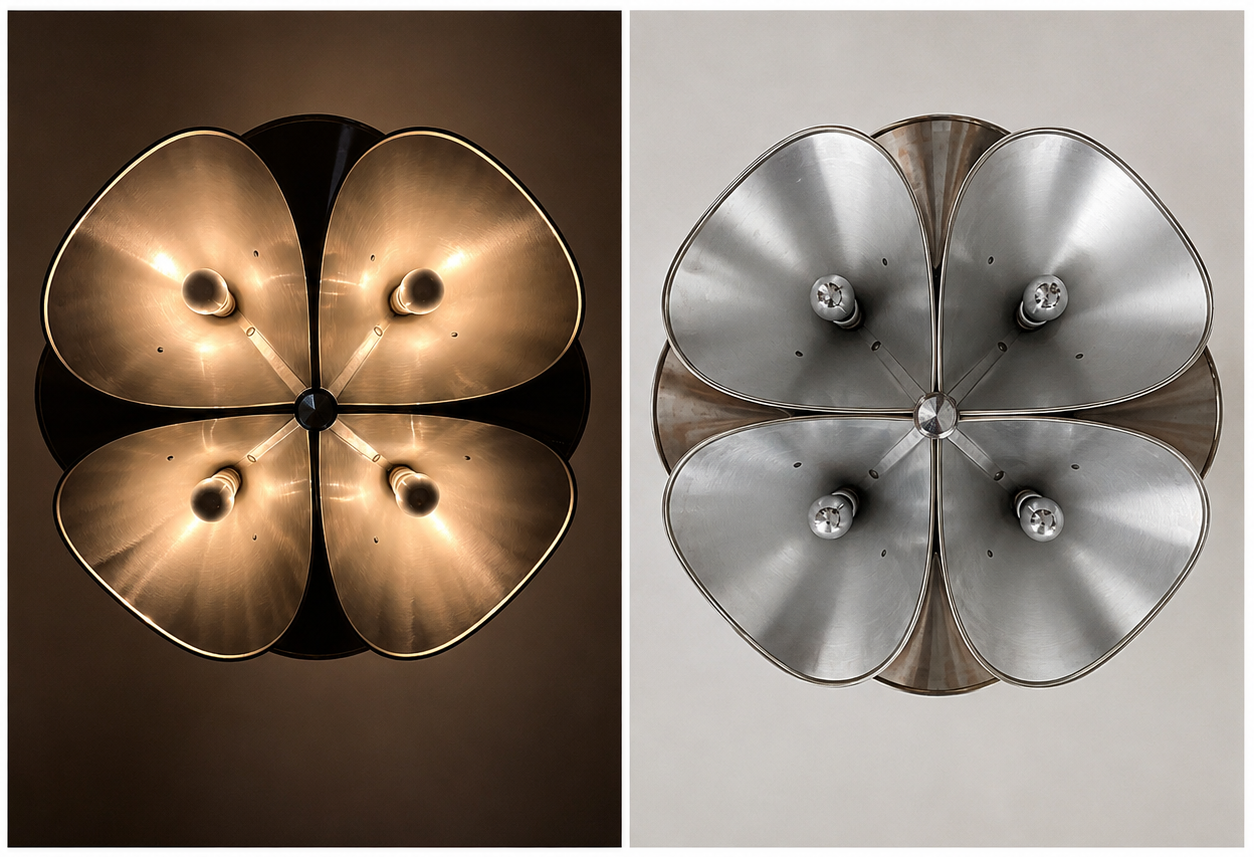
The record for Quadrifoglio di luce documents a suspended chandelier by Augusto Oppo, without a certain date, approximately 30 cm high and 72 cm wide. Its name is a catalogue designation; a family note places the object in the living room of the artist’s first home after marriage. It should therefore be considered in two inseparable ways: as a device made to light a room and as a composition of metal surfaces visible from multiple positions. Two photographs taken from below, one with the lamps on and one with them off, make the change apparent. The same structure moves from cool silver to copper-gold reflections without any alteration to its geometry.
At the center is a small circle from which oblique arms extend. Large droplet-shaped cups open around it, with rounded edges and concave surfaces. Four stand out clearly in the lower view, arranged like a four-leaf clover; other metal elements appear behind them in the gaps. The record describes eight bent sheets of stainless steel and eight points of light, but a photograph from directly below does not show every component in the same way. The difference between construction notes and the available image is a reason to examine the object from several angles, not to reduce its complexity to the most immediate silhouette.
With the lamps off, the surfaces show fine striations and shifts in sheen following the metal’s curves. The mirrored light bulbs appear as small cylinders or spheres at the center of each visible cup. Radial symmetry makes the structure readable without flattening it. Metal reflects differently near the edges, around the bulbs and toward the middle; each bend changes how ambient light strikes it. The central circle gathers the directions, while the metal petals send them outward. The form seems enclosed when viewed in plan, yet open in depth.
With the lamps on, the relation reverses. The concave parts hold a warm glow, their rims become continuous luminous lines, and the dark gaps behind the cups gain depth. Light is not an effect added to an already completed sculpture: it changes what can be perceived of the object. The bulbs remain visible and have a formal role as well as a technical one. They make its practical purpose explicit, while the repeated metal drops turn emitted light into an order recognizable from the floor.
The extended biography of Oppo documents his work in graphic art, design and metalwork. This context explains why a domestic object belongs within the artistic corpus without pretending that it is a painting. The precise bends, choice of reflective material and attention to the room are design decisions. Yet the radial form also produces an image in its own right: an arrangement of solid areas and voids that changes with the viewer’s position. The interest of the work lies in its dual belonging to functional design and three-dimensional artistic inquiry.
The most direct comparison is with Fondale marino, a floor lamp in the corpus. There, an upright, continuous structure diffuses light through marked surfaces; here, the object extends horizontally overhead and individual cups produce the reflections. Both bring an investigation of surfaces into a lighting device, but create opposite experiences of space: a vertical presence close at hand in one case, a suspended radial center in the other. There is no proof that they formed one designed series or share a reliable date.
Critical Aspects
The family note provides a domestic context of use, but not a date of manufacture. The record specifies bent stainless steel, metal edging and E27 mirrored bulbs—technical information more exact than the image alone could supply. Its archival origin should remain clear. Component counts also call for care: four cups dominate the lower view, whereas the description lists eight metal sheets and eight bulbs. A full set of side views or direct examination would be needed to reconstruct assembly, the arrangement of layers and present condition precisely. A photograph is one view, not a construction drawing.
The flowerlike appearance could tempt us to treat the chandelier as a naturalistic imitation. The resemblance helps orient the eye, but its form comes from geometric bends and joints, not from a flower described in detail. The editorial name “Quadrifoglio di luce” draws attention to the four cups visible from below; it does not replace the more elaborate structure recorded in the catalogue. Critical reading must distinguish the perceived silhouette, the object’s actual construction and its lighting function. To collapse them would obscure the most interesting passage: how a repeated unit becomes a presence in space.
A second comparison is the Fregio per controsoffitto of 1968. The frieze runs along a room and organizes a sequence of pale reliefs near the ceiling; the chandelier instead concentrates its relation to the room at a single suspended point. Neither can be fully understood apart from its setting, because height, boundaries and light alter perception. The difference in material and purpose remains essential: shaped and painted polystyrene in the frieze, bent metal and light sources in the chandelier. Their kinship is one of design, not technique.
Photographs with lamps on and off also remind us that color rendition is not fixed. Silver stainless steel takes on warm tones when it reflects artificial light; the dark background of the illuminated view increases contrast. To call the metal “golden” as a material property would mislead. Reflections also depend on camera angle. The object deserves assessment as a changing device whose formal balance survives shifts in illumination, although that balance does not always appear in the same way.
Evaluation
Quadrifoglio di luce shows an important aspect of Oppo’s work: his ability to bring an investigation of units, surfaces and reflections into a practical object. The view from below is strong and immediate, but not simple. The center organizes the arms, the cups curve the light, and dark intervals prevent the volume from becoming a uniform disc. Repetition does not erase differences in reflection and depth; it makes them legible. The functional solution sustains a sculptural reading as well.
Within the corpus, dialogue with Fondale marino and the Fregio per controsoffitto clarifies the continuity of a question: how an artwork can inhabit a room and change its perception. Each answer differs in scale, material and purpose. The chandelier is the case in which the light produced by the object itself enters the design and changes its appearance. That condition distinguishes it from a relief merely lit from outside.
Documentation leaves its year, assembly history and a complete view of the eight components listed in the record unresolved. Within these limits, the judgment is clear: Oppo draws a memorable form from a repeated constructive principle without sacrificing domestic use. Its quality lies not only in the effect when lit, but in the coherence with which it remains compelling when switched off, as a geometry of metal and space.