Critical reading
Reliquia dell’umano: a figure persisting in gray
Black contours and pale reserves suggest a possible presence inside a broad gray form. The body appears, then begins to come apart.
Critical Reading
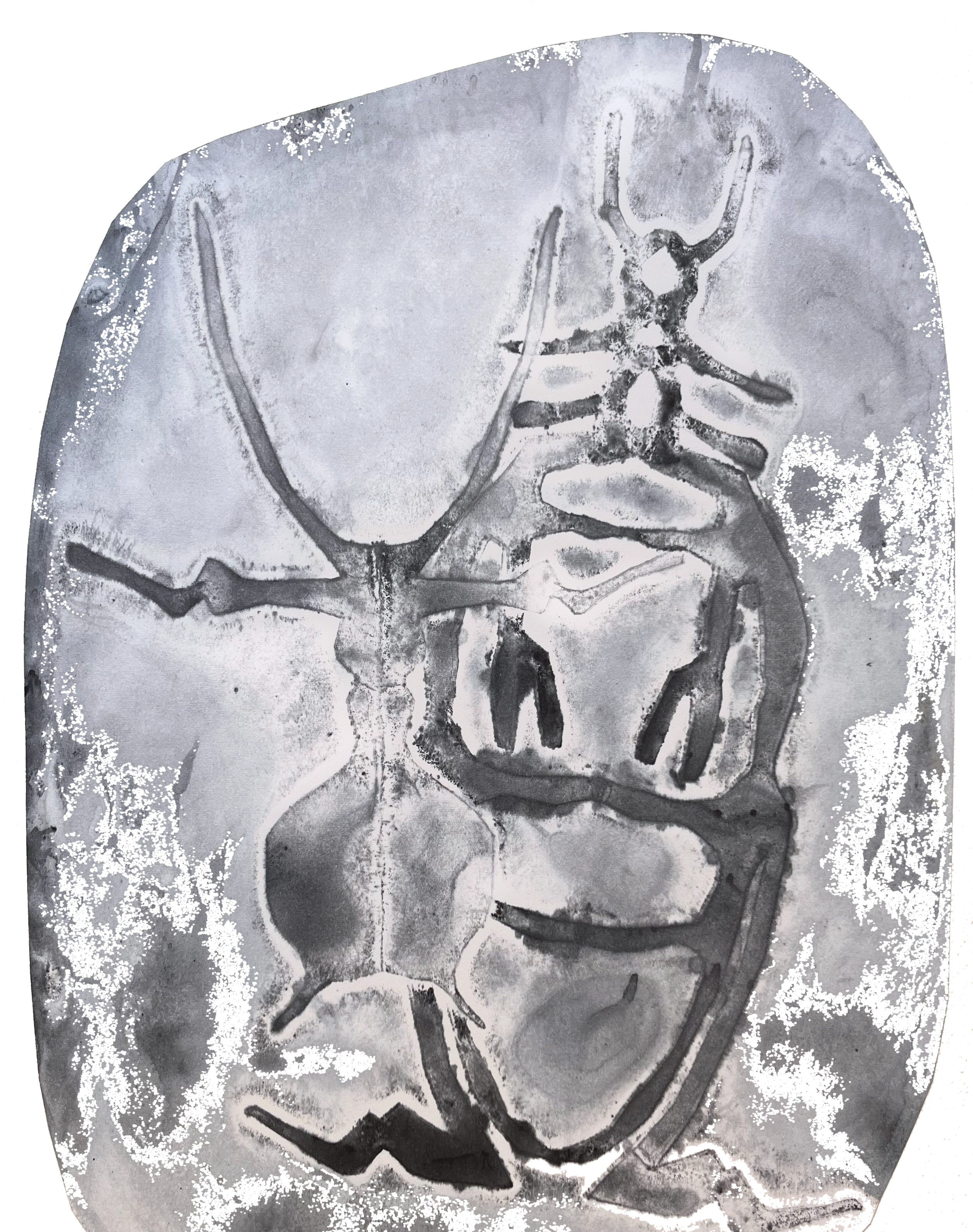
The record for Reliquia dell’umano gives 1966 and 30 × 38 cm, without naming a technique. Photography shows a broad gray area with rounded margins on a pale support. Inside it, black marks, white reserves and gray transitions interweave to suggest a figure without defining coherent anatomy. At upper right, a branching shape might recall raised arms or an articulated head; other lines bend, join and break at center and below. The Archive’s title evokes a “relic,” but no particular ritual object is documented in the record.
The outer edge of the gray field is relatively calm. It opens as an irregular oval, lighter above and denser below. Inner marks, by contrast, change direction and scale. A broad curve rises from the left and bends inward; a horizontal line crosses the image’s body; short parallel strokes gather below a taller structure on the right. The eye tries to join them as limbs, but some passages remain deliberately ambiguous. A figure does not stand before gray like a character on a backdrop: it seems to grow from changes of density.
White reserves take different forms. A broad zone at upper left opens space; narrower ones fit among dark marks on the right. Below, a pale passage separates two dark areas and changes their direction. Black is no uniform line either: it thickens, thins and sometimes dissolves into gray. The effect resembles drawing held in a material field, but reproduction cannot establish how it was made. With no technique in the record, analysis must stay with texture and visible relations.
The composition oscillates between nearness and distance. Far away, its gray oval looks like an isolated artifact on the sheet; closer by, internal strokes become mobile enough to suggest gestures or bodily fragments. Signature and 1966 are not evident in the portion of the photograph shown, although the catalogue records the date. That visual limit makes a distinction between recorded fact and formal reading essential. An attempt at figuration can be recognized without claiming a particular pose or identity.
Critical Aspects
“Reliquia dell’umano” is a catalogue designation powerfully guiding perception. “Relic” may suggest antiquity, worship or survival of a body, yet the work documents no artifact, archaeological source or sacred subject. The metaphor helps if it names the figure’s partial character: something human seems to remain amid incomplete marks and worn-looking surfaces. Beyond that it would become invented history. Criticism should leave open ambiguity among body, trace and form.
The extensive gray field might smother black marks. Instead, it makes them less stable and more active. Paler areas bring strokes forward; darker ones take them back in. Reading them as one continuous contour fails. Each fragment depends on its neighboring tone. That may be less immediate than a body outlined against white, but it is this work’s distinctive character. Figure forms in the relation between mark and field, not by adding anatomical details together.
Photography suggests a complex surface of shifts and apparent impressions. The record does not specify materials, support or process. Calling the work relief, print or engraving would therefore be unwarranted, even if certain effects recall them. Relation between gray margin and pale sheet may also be affected by the original’s condition and the photograph. Formal assessment remains possible: a broad perimeter contains a network of marks tending toward figuration and resisting it at the same time.
Comparison with Idolo fragile, also recorded in 1966, shows two ways to join body and mark. In Idolo fragile a crisp black silhouette holds pale units inside; here no single perimeter defines a body, and dark marks surface from a broad gray field. Kinship lies in efforts to make the human appear with reduced means, not in repeating one figure. Together they move from frontal stability to dispersal without supplying an undocumented chronology.
Evaluation
Reliquia dell’umano convinces because it never forces recognition. A suggested presence can be seen, lost and found elsewhere in the composition. The left-hand curve, branching strokes at upper right and openings below do not make a fully legible body; together, however, they prevent the gray field from being a pure abstraction indifferent to figure. The work gains critical depth in that middle space. Looking must participate without inventing more than the image permits.
In Il sigillo aperto, from the same year, a black mass contains light openings that might become inner figures. Here the relation is less sharp: gray mediates between mark and ground, and white is not only a piercing void. Both question the arrival of ambiguous presences, with different weights. The comparison shows reduced color need not mean one formal solution; changing the density of the field changes how a body emerges.
The rounded outer shape is almost protective. Without it, inner marks would scatter over the sheet; with it, they become parts of one organism. Its irregular border nonetheless prevents the oval from being a perfect vessel. The work retains a vulnerability consistent with the catalogue name. Whether that comes from process or application cannot be said from the record. It is perceptible in continuous differences among gray, black and light reserves.
Within Oppo’s corpus, this 1966 sheet asks how much of a figure remains recognizable when material absorbs it. Here the answer is neither a secure silhouette nor disappearance, but a cluster of clues holding a body in provisional form. Favorable assessment comes from that measure, not from an assigned ritual meaning. “Relic” can remain a useful word for what survives; the actual experience is a figure slowly coming into view within gray. The pale outer space is part of that slow emergence: it isolates a provisional body but gives no surroundings that would settle its identity. Returning from the edge to the marks repeats the central question of recognition each time.