Critical reading
Totem meccanico: relief objects and uncertain order
Forms recalling tools, rings and machine parts occupy a gray field. Light gives them volume without disclosing how they might work.
Critical Reading
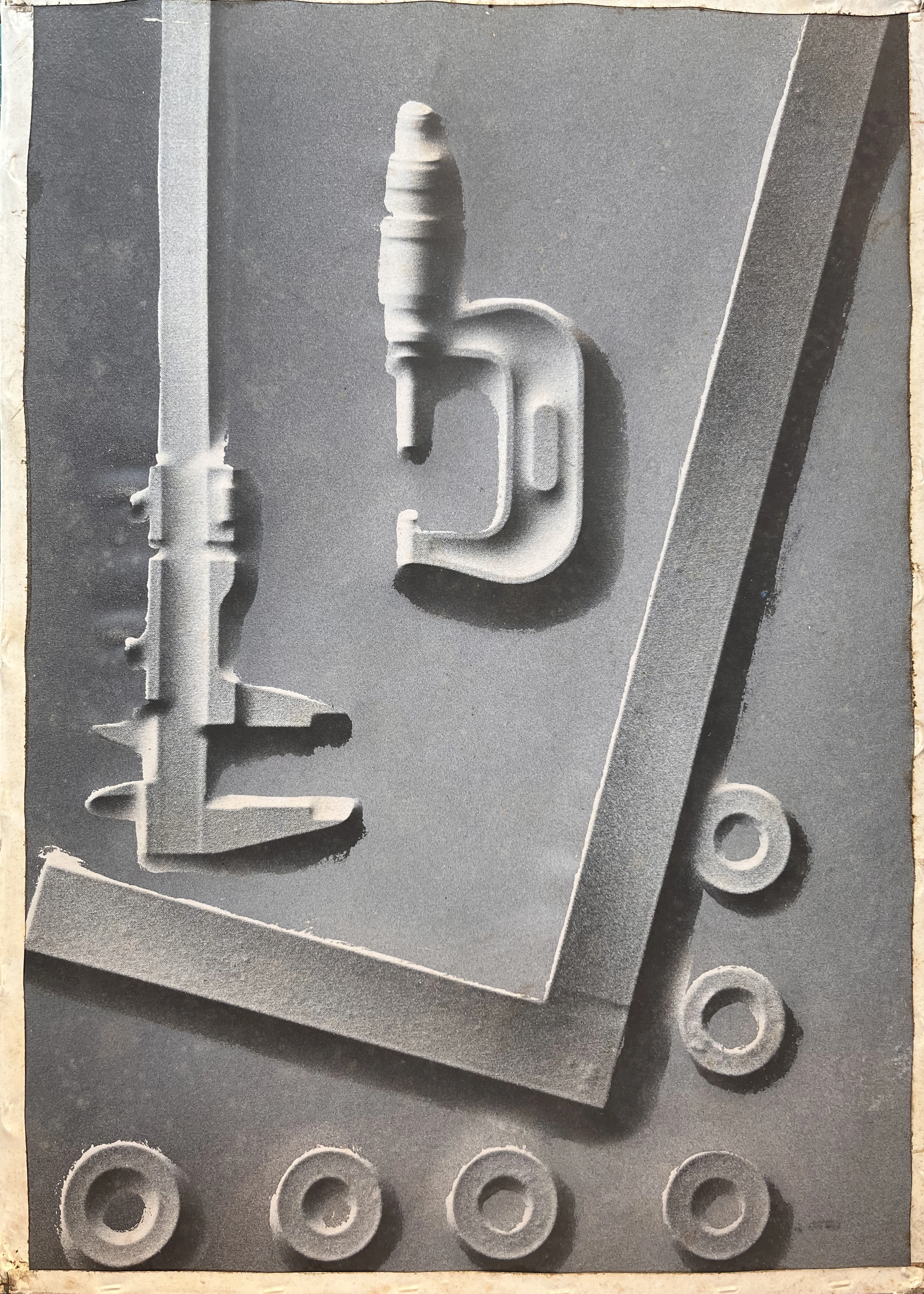
The record for Totem meccanico gives 30 × 42 cm without a year or certain material. Its title is an Archive catalogue designation: “totem” suggests an emblematic presence and “mechanical” recalls the forms of its parts, but neither identifies a real object. Photography shows a gray field framed by a large tilted rectangular outline. Pale forms casting shadows sit inside and along its edges. The composition reads as a system of separate pieces, not a drawing of a functioning machine. Their placement suggests order even where their purpose remains unknown.
A long upright stem rises at left, interrupted by joints, small corners and short projections. It widens into an angular base below; higher up, continuity seems to break near a transverse element. Toward the center, a suspended U-shaped form holds a cylinder pointing downward. Rings or constrictions alter this body’s profile. The relation between stem and curve stays open. They are near enough to occupy one field of forces, but no mechanism visibly joins them. The eye recognizes the vocabulary of components without finding an operation that would put them to use.
The large tilted edge performs another task. At right it descends like a wide beam, then bends down toward the left to create a corner containing smaller forms. Small circular rings align near the right side and lower margin. They are more than decorative dots: repetition gives the other parts a scale and introduces regular rhythm among unequal pieces. Shadows surrounding each element make it appear raised above the gray plane, while the frame creates a broader depth. The tiny circles and long bars belong together as a visual arrangement, even if they cannot be assembled into a known device.
Monochrome does not erase differences. Ground remains compact gray; raised surfaces catch light along edges and darken on their sides; hollows of rings become nearly black. Looking moves from long vertical volume to curved one, then to low circles, measuring a new relation of solid and void at each step. The photograph also retains a material border around the field. This outer frame reminds us that we view a reproduced object and asks us to distinguish the relief’s physical presence from the image available to us. The visible shadows warrant attention without revealing the substance that casts them.
Critical Aspects
Resemblance to tools or industrial parts is evident but insufficient to assign a function. A U-shape may recall a bracket, the stem a support and the rings washers. Yet the work does not connect them according to a verifiable technical principle. Interest arises from removing familiar forms from the context that would make them immediately useful. They remain close to objects while behaving as abstract signs distributed in measured space. The visual order is exact enough to invite mechanical guesses and open enough to resist their completion.
Materiality also needs to be read within the evidence. Shadows and lit edges indicate visible projection in the reproduction, but the record names neither material nor assembly process. Calling the relief metal, plaster or ceramic would be unsupported inference. Direct examination might clarify weight, surface and depth. For now photography permits description of relations: pale elements raised against gray, shadows varying with form, a sequence of rings and large slanted segments. These observations are concrete without pretending to answer the technical questions left open by the record.
Comparison with Pinze is pertinent to the transformation of mechanical objects into isolated presences on a monochrome field. In that relief two shapes recognizable as pliers lie horizontally and retain a strong memory of use. Here the parts are more fragmented and do not reconstitute one tool. Juxtaposition proves neither equal date nor material. It clarifies a threshold between an object one can name and a part becoming a sign. In Totem meccanico, uncertainty of function is structural rather than incidental.
In Colonna d’ombra, dated 1979, gray relief concentrates its surface in a vertical band of small projections. Totem meccanico instead distributes differently sized volumes within a slanted perimeter and leaves wide smooth zones between them. Shared gray and relief do not establish identical technique. The difference between concentration and dispersal is more useful than trying to assign the works to one series. With no catalogued year for this work, comparison remains formal and establishes no chronological priority.
Evaluation
The work’s merit is the coexistence of rigorous construction with an inventory of enigmatic forms. The large tilted rectangle gives the whole a rule; left-hand stem and central curve provide secondary axes; rings introduce small repetitions. Nothing seems randomly thrown on the ground, yet no relation resolves into a machine’s function. The composition preserves the pleasure of close observation. Looking tries to see how the pieces might fit and discovers that their unity is visual. The suggested mechanism is most engaging where it fails to become one.
Light does decisive work. Pale edges outline projection, shadows make it tangible, and unoccupied ground makes each interval perceptible. The effect relies less on strong chromatic contrast than on the minimal depth each piece introduces. Were the entire surface filled, the eye would lose the hierarchy between large profile and small rings. Gray pauses allow an almost architectural rhythm without making the relief depict a building. Volume and empty space remain equally active parts of the construction.
The catalogue title helps formulate a reading as long as it is not imposed as explanation. “Totem” certifies no ritual meaning; “mechanical” attests no engineering project. Both point to perceptible qualities: the isolation of an almost symbolic presence and the memory of constructed parts. Positive assessment follows the precision with which these qualities remain in tension. The work makes the material world familiar without restoring the comfort of a settled name or use. It invites interpretation while keeping its claims tied to visible form.
Within Augusto Oppo’s corpus, this relief shows an interest in the object once it ceases to serve and becomes form. Gray field, slanted angle and repeated rings build coherent space but leave questions the image need not close. Missing date and material do not prevent rigorous critical reading; they define its limits. The result persuades because an apparently technical assemblage generates a slow, tactile experience unexpectedly distant from any instruction manual. What remains memorable is the patient movement between lit edges, dark hollows and intervals of gray.