Critical reading
A Italo con affetto: dark gesture and pale space
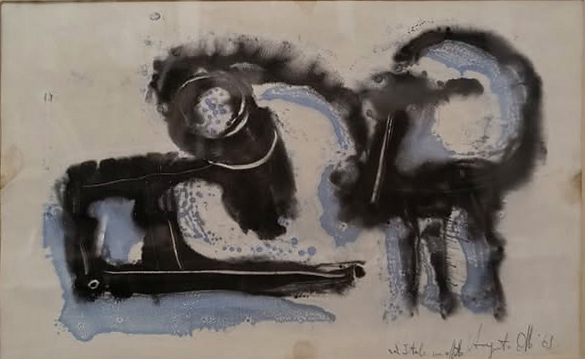
The autograph dedication “A Italo con affetto Augusto Oppo 68” records a recipient and year. Two dark clusters joined by lines and washes occupy only part of a pale field: the composition lives through gesture and surrounding emptiness.
Critical Reading
The record for A Italo con affetto describes a 35 × 25 cm work in the Motroni Collection. At lower right in the photograph the dedication “A Italo con affetto Augusto Oppo 68” can be read: recipient and year 1968 are therefore directly documented by the inscription. The Archive title repeats its words but is not attested as a formal title chosen by the artist; technique and support are unspecified. Two clusters of black and blue-grey occupy a pale field, the broader at left and the taller at right. Curved lines and small sharp marks run between them. The image describes no identifiable objects: its presence arises from dense signs and almost empty zones supporting one another.
The left cluster begins in a deep, irregular horizontal black band. Above it a broader form bends and rises, with blue-grey interrupting the darkness. A small pale circle above is surrounded by dark marks and a thin ring. The horizontal band gives the group visual footing, while the circle draws it upward. That circle need not be turned into an eye or a particular object: its role is to open a pause within black. The left mass thus avoids uniformity. White around it remains visible between strokes, letting its construction be followed.
At right the form is more vertical and open. A dark arc almost closes on itself above, leaving a pale patch at its centre; below, black lines descend among bluish washes. The group seems to answer the left without copying it. One is broad and anchored below, the other gathered above and crossed by runs of colour. The space between them is no accidental gap. Curves and grey transitions make a relation visible, as though energy from the first cluster continued in the second while changing direction. Oppo builds a dialogue of weights, not a symmetrical pair of figures. Reading repeatedly moves from one to the other and back to the marks between.
Blue-grey has a discreet but decisive role. It appears beneath the left black bar, around the central arc and within the right cluster, without filling the whole ground. This distribution prevents a rigid split between “black” and “white.” Cool washes lend depth to the groups and soften some meetings of line and void. In places they seem to lie below black, in others beside it. The photograph cannot securely reconstruct the order of application or identify the medium used; one can observe alternation between diluted passages and firmer strokes. A mark flows, stops, then leaves a small run carrying movement downward.
The broad pale field around the groups has compositional value equal to the patches. Above and along the edges it remains almost free of imagery; below, handwriting adds a different, thin and legible accent. Proportion between free space and dense zones makes the work feel like concentrated gesture rather than unfinished surface. Darkest parts occupy a middle band while writing stays low at right. That distance prevents the dedication from acting as a caption pasted to a patch: it is a personal act sharing the same visual sheet without taking over interpretation. Italo can be named as recipient, but neither his biography nor the gift’s occasion follows from the available facts.
The reproduction retains the entire photographed area, and the record notes that the sheet’s visual aspect appears wider than the reported measurements suggest. This discrepancy has been kept without distorting the image; it should not be settled by imagining a crop or a different original format. For reading, the horizontal field lets the two groups breathe. Black at left establishes a base, black at right a height, and the pale area between becomes an active pause. From a distance the work appears rapid; close up, varied passages reveal careful control of each gesture’s weight. The inscription gives it a year and recipient, not a hidden figurative subject.
Critical Aspects
Comparison with the untitled work of 1961 concerns the relation between dark gesture and pale ground. There a broad black band occupies the bottom while lighter curves rise over it; contrast is direct, almost graphic. A Italo con affetto instead concentrates two separate groups, includes blue-grey washes and leaves more empty space among marks. Both images show how unpainted surface can take part in composition. They are not the same exercise repeated: the division into two clusters and the dedication alter rhythm and presence in the 1968 sheet. The earlier date belongs to its own record and proves no continuity of technique with the later, materially undocumented work.
Reticolo notturno, dated 1968, offers a useful opposite within the same year. It is a dark composition crossed by incisions and brown and green tones filling almost the whole surface. Here the pale ground remains broad and energy gathers in a few black and bluish patches. Shared chronology does not put them in a series. Rather, it shows Oppo’s willingness in documented 1968 to pursue distant visual solutions: material density in one, economy of mark in the other. In the sheet dedicated to Italo, emptiness exposes every curve; in Reticolo notturno marks must find a path through a surface already dense.
The composition Il colorato, also communicated by the Motroni Collection, distributes blue, ochre, red and green fields across a small, almost full surface. A Italo con affetto offers its visual opposite: restrained palette, broad pale pauses and dark clusters connected by few lines. Comparison is not based merely on common provenance, which attests neither a series nor shared date. It reveals differing arrangements of distance between parts: in Il colorato, through borders between adjacent fields; here, through free space crossed only partly by lines. Attention to presence and interval is shared, but yields radically different tones.
The dedication is direct evidence and deserves the same precision as the black forms. “A Italo con affetto” gives recipient and personal register; “Augusto Oppo 68” gives author and year. It says nothing about who Italo was, where the sheet was delivered or what event prompted it. The record documents none of those circumstances, and criticism should not fill them with a plausible tale. Nor should writing be detached as merely inventory data. Its small but visible presence ties the abstract composition to a genuinely attested personal relationship. The conjunction of free marks and address to another person distinguishes this sheet from an anonymous trial.
Evaluation
The work convinces through measured gesture. Black has enough force to create two centres of gravity without filling the field; blue-grey joins them without erasing their difference. The left form holds the bottom with an energetic bar; the right closes an arc above and lets light through at its centre. Light lines between prevent distance from becoming absolute separation. This is an open but not random composition: each group has a distinct role, and void regulates their relation. Its intensity comes from stopping the mark before it becomes description. The eye keeps following possible connections without having to identify an object.
The dedication is well placed too. It is read at the lower edge after crossing the clusters, and retrospectively changes how the scene is felt: one no longer looks at an abstraction without an addressee, but at work offered to someone. This does not require the two patches to be read as two people or symbols of a particular relationship; the photograph supports no such identification. It does offer a verifiable human dimension entrusted to writing itself. The composition retains visual autonomy while its inscription gives its history more substance. The balance between these two presences, gesture and word, is among the sheet’s subtler achievements.
Autograph evidence of 1968 permits comparison with works of that year, but missing technique and support warn against assigning this sheet a process by analogy. Within those limits, A Italo con affetto is telling evidence of Oppo’s ability to put white to work alongside black. Beside the density of Reticolo notturno and the multiple colours of Il colorato, a few marks suffice here to make a tense, personal visual field. Its value does not depend on recognising hidden figures: it rests on the precision with which a bar, an arc, two washes and a dedication make presence, distance and affection felt without illustrating a story the source does not tell.