Critical reading
A presence between red, shadow, and gold
A vertical silhouette defines itself between dark fields, reddish-browns, and golden brightness. Figure and surface remain in an open relationship, without undocumented identifications.
Critical reading
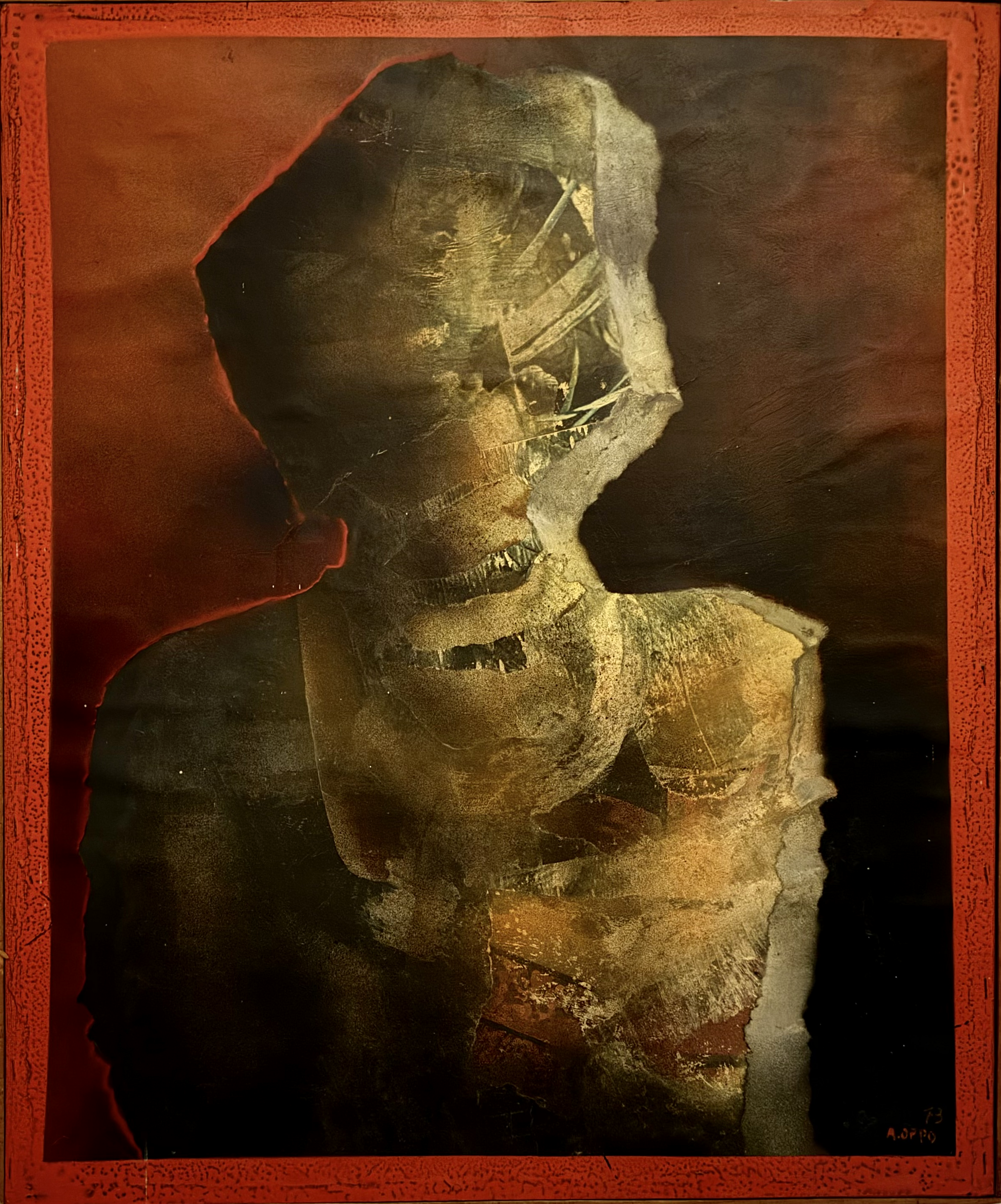
A vertical presence occupies the center of the composition, emerging from an environment dominated by reddish-browns, dark zones, and golden passages. The silhouette may suggest a head, a profile, or a bust, but it does not present itself as an easily identifiable descriptive portrait. Its recognition remains partial: some elements recall the human figure, while others insist on the quality of the surface and the overlapping of forms. The work entry therefore adopts a descriptive designation. “Figure in red and gold” indicates a reading of the image and its colors, without attributing an undocumented title to the author.
The central field is constructed through passages that vary from dark brown to lighter, ochre, and golden tones. Along the right side, a luminous band follows an irregular path, then widens in an area that may recall a shoulder. This brightness separates the presence from the background and simultaneously complicates its boundary. We do not see a simple outline filled with color: the limit appears produced by the encounter between different surfaces. The term “golden” here describes a chromatic effect of the photograph; it does not certify the use of gold leaf, specific pigments, or other techniques that would require direct verification.
On the left side, a red margin accompanies part of the dark mass and establishes a more subtle relationship with the background. Instead of completely isolating the figure, that edge puts it in contact with the surrounding chromatic environment. Observation can oscillate between the general profile and the internal details, in which streaks, discontinuities, and overlapping passages appear. Some marks seem to emphasize a transverse direction, others accompany the verticality. The result is not a stable anatomical description: it is a construction that allows the human reference to remain recognizable without controlling every part of the reading.
The background does not possess a uniform intensity. More reddish zones and very dark areas alternate around the form, creating different conditions of visibility. The upper part allows for a relatively wide margin; towards the bottom, the presence widens and acquires a tighter relationship with the edge. A perimeter red band, clearly visible in the shot, also contributes to the perception of the overall limit. The reproduction preserves its appearance without deciding, based on the photograph alone, every detail of its material nature. The relationship between center, environment, and limit remains, however, an observable fact and participates in the strength of the whole.
Critical aspects
The work invites one to consider the figure as a possibility that forms within the visible matter, rather than as a fully resolved outline to which details are added. The resemblance to a head or a bust guides the gaze but leaves various readings open. It is not necessary to assign an identity to the character, nor to assume a self-portrait, to recognize the intensity of the presence. The central silhouette establishes a direction, gathers lights and shadows, and establishes a scale. These compositional functions precede any narrative hypothesis and allow for a discussion of the work's construction without depending on an unattested subject.
Another relevant aspect is the distance between the general contour and the internal marks. From a distance, a relatively compact form prevails; approaching, that compactness decomposes into different episodes. The light zones do not always coincide with a coherent ambient light, just as the dark zones do not all function as descriptive shadows. The relationship between these values seems to organize the surface above all. The human presence is therefore proposed and at the same time called into question: it remains a possible guide, while the quality of the passages prevents reducing the work to a simple silhouette.
The original photograph shows the signature and the date “73” at the bottom right, consistent with the year 1973 indicated in the submission. The catalogue record distinguishes this evidence from critical interpretation: the date alone does not prove membership in a series, a specific occasion, or a relationship with other works. The dimensions of 59 × 71 centimeters and the indication of cardboard come from the information received. The technique is not documented sufficiently for a specific definition. Keeping these sources separate prevents the richness of the image from being transformed into a material or historical certainty that the available documentation does not support.
Comparison with other works in the Archive can be useful for observing the relationship between the recognizability of the figure and the autonomy of the mark. It must, however, retain an exploratory function. Chromatic recurrences and layout analogies do not authorize the automatic establishment of influences, stylistic shifts, or hierarchies. Here, the clearest evidence is the way in which a central form is made present through differences in tone and consistency. Its position does not erase the background: on the contrary, the surrounding field intervenes continuously in the definition of the silhouette, alternating separation, continuity, and contrast.
Evaluation
The quality of the work lies in the tension between a presence that tends to gather and a surface that continues to open in different directions. The vertical movement suggests stability; the irregularities of the margins and the internal passages make it less definitive. The red provides an energetic environment, while the golden zone introduces a more concentrated brightness. These components are not simply superimposed: their relationship modifies from time to time what appears as figure and what appears as background. It is in this reciprocity that the composition finds a continuity capable of sustaining repeated observations.
The assessment must take into account the the mediation of photography. We cannot establish from the reproduction the real reflectance of the brighter parts, the depth of the layers, or the presence of specific materials. Some variations may be accentuated by the shooting conditions; others may belong to the surface. The geometric correction serves to make the organization more readable, not to certify the material appearance of the original. For the same reason, the signature and date are preserved through the samples of the photograph, without redrawing them. A greater regularity of the published image must not be confused with new data on the execution or conservation of the work.
Within these limits, the composition proposes an intense image without relying on a meticulous description of the subject. The interest arises from the ability to make a presence emerge and to maintain it in relationship with what could dissolve it: darkness, irregularities, density of the passages. The luminous center does not eliminate ambiguity, but makes it more perceptible. The gaze can recognize a figure, pause on the marks, then return to the whole, modifying its own reading. This openness to changing readings does not weaken the structure: it shows how a simple arrangement, based on a vertical and a few chromatic relationships, can accommodate a considerable visual complexity.