Critical reading
La parete del tempo: a grid crossed by light
Black lines partition a grey field into unequal bands. Within the grid, folds and yellow openings seem to appear and disappear.
Critical Reading
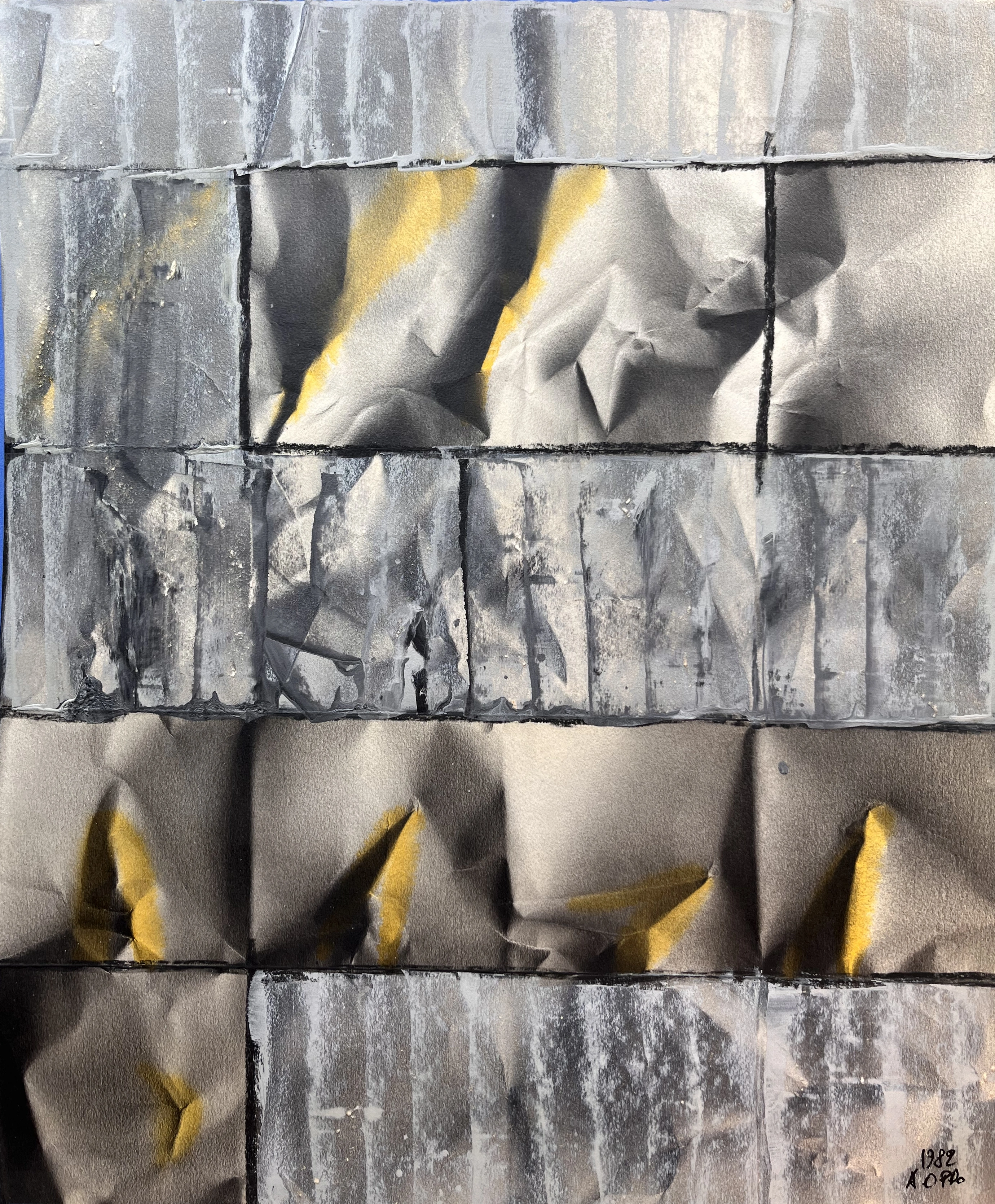
The record for La parete del tempo gives 1982 and 43 × 52 centimetres without specifying the medium. Its designation is catalogued by the Archive and not documented as the artist's choice. Black lines cross the vertical format, dividing a mainly grey field into horizontal bands and sectors of varying width. Within these divisions emerge pale folds, triangular shadows, apparent tears and small yellow flashes. The structure evokes a wall only visually: no bricks, mortar or identifiable setting can be seen. Instead, the work relates geometric partition to surfaces that seem to keep changing. The grid gives a firm first impression, while internal variations complicate it.
Above is a broad band of pale greys. Tonal variations follow nearly vertical directions, and a dark, slightly irregular line marks its lower edge. Just beneath, light grows more dramatic. Yellow opens toward the left, crossed by a large pale form apparently folding; at centre a black shadow sinks and then rises in a softer profile. Greys gather in an oblique area at right. The horizontal line closing this section is more than a separator. It becomes a threshold on which apparent volume seems to rest or break off. Its presence gives the modelled forms a measure without fixing what they depict. Light and edge act together.
The middle band changes pace. Grey is more fragmented, with dark traces and pale passages resembling a worn surface without revealing how it was made. Black verticals cut some areas decisively but elsewhere break or lose strength. The result is no uniform checkerboard. Some sectors seem to continue beyond their boundaries, while others close over opaque concentrations. A viewer can follow the lines to read the overall design and then lose them amid tonal shifts. This alternation keeps the grid from ruling everything it contains. The picture is structured but not imprisoned by its structure. Its apparent material variation remains a visible effect.
Lower down, yellow fissure-like openings appear in darker grey fields. They are irregular: at left a blade rises from black, in the centre an oblique light narrows, at right another opening seems to break. Intervals of shadow carry different weights between them. The final band returns to a paler, flecked grey; signature and ‘1982’ are visible at lower right. The work does not move toward a final revelation. Light is distributed intermittently, as though each section had its own visual duration. The eye descends and then returns to lines holding the system together. The separate flashes remain part of one plane.
Critical Aspects
The Archive title carries a temporal metaphor, but the surface offers no readable chronology. There are no successive dates, inscriptions or stages of a narrated transformation. Time is felt in the way vision slows: each band calls for refocusing, and each move from grey to yellow changes one's relation to the grid. ‘Wall’ is apt for frontality and division, but a real wall or specific architectural memory would be an interpretive leap. The picture gives visual thickness to a plane still firmly before us. Its apparent duration is the duration of looking, not evidence of elapsed events.
Black lines do not all perform the same task. Some sharply separate bands; others cross a zone like residual traces and stop short of the next edge. Irregularity matters, combining an idea of measure with a sense of process. The middle band, richer in small signs, makes this tension clearest. There the network seems almost absorbed by internal changes; above and below it regains command of surface organization. A rhythm of assertion and loss results, more complex than a grid simply overlaid on an image. The structure itself varies in strength as attention moves downward. Its boundaries are active events.
Yellow is scarce but organizes looking. High up it accompanies large pale forms; below it returns as narrower openings wedged into black. Change of scale makes sectors feel like distinct moments without turning them into episodes of a story. Grey changes as well: silvery areas, warm almost-beige passages and dark fields answer one another across distance. This is not monochrome with decorative additions. A restricted range lets us see how much a slight shift in value, a shadow's direction and an opening's place relative to the framework matter. Small colour differences animate broad zones.
In Il movimento congelato, also from 1982, large grey forms seem to fold and twist in one continuous pale space. Comparison is close for light-dark modelling and the uncertainty whether one sees an object or a plastic apparition. There, the central body dominates without a grid; here, black bands interrupt and measure folds. The impact changes: the other picture concentrates around one mass, while La parete del tempo offers multiple zones of attention. No documented preparatory relation follows. The distinction is between gathered movement and measured dispersion.
Archivio delle possibilità, again from 1982, provides an opposite comparison. A white network divides numerous blue and violet cells full of relatively independent signs. Kinship lies in partition as a visual device, but density and colour differ. There, each cell holds nearly a separate small event and the outer border is saturated blue. Here, the network is black, bands are broader, and greys pass across divisions to keep one broad breath. A shared documented year permits exact comparison, not a claim of common technical procedure. The grids conduct different kinds of looking.
Augusto Oppo's biography recalls his interests in architecture and surface organization. This offers useful context for an image of cuts and intervals without making it a designed building. The record leaves technique open; apparent folds or relief must be framed as effects perceived in photography, not identified material. By contrast, the year is present both in the catalogue and the image. Distinguishing those documentary levels helps locate the work accurately within the corpus and preserve the form's freedom. Its partition need not be architectural fact, and its light need not describe physical openings.
Evaluation
La parete del tempo convinces because structure does not suffocate what it organizes. Black lines give immediate measure; greys, folds and yellow openings test it in every band. The strongest passage is between an upper zone modelled by broad lights and a more marked, uncertain middle band. The eye senses chromatic continuity but must change its way of reading. Lower down, yellow returns in small taut fragments. The picture keeps vertical movement without relying on a narrative or recognizable subject. Division gives passage rather than stopping it entirely.
The restricted range lends weight to small differences. Pale grey can nearly seem white until it meets a black line; a yellow fissure gains force through isolation; a dark patch seems deep without coherent perspective. The composition calls for close viewing and then a step back. Nearby one sees edges and interruptions; from afar the whole wall-like system returns as bands. This double reading prevents reduction either to material suggestion alone or to geometry alone. Their meeting is the work's durable interest. Visual depth remains within its frontal organization.
Within the 1982 corpus, the free mass of Il movimento congelato and dense network of Archivio delle possibilità clarify this work's particular choice. Oppo distributes apparent relief through sectors broad enough to let it breathe yet defined enough to reveal its variations. The catalogue title is an effective metaphor if kept as a proposal for reading. Value lies in tension between continuity and fracture: a wall one can visually measure, yet one that changes with each passage of light. The picture is neither an actual wall nor an abstract diagram.